What is different between Male vs Female Plants in cannabis?
Male and Female weed plants
Cannabis plants have evolved enormously over the past couple of decades, mainly thanks to human kind. We’ve spent years combining different species from all over the planet. Every strain has its own specific characteristics, such as structure, type of buds, flavor and effects. When you combine male and female weed plants that are different strains, the new creation takes on characteristics from both, allowing us to create totally new plants.
One of the biggest evolutions has been the appearance of feminized plants; after years and years of work, cannabis plants can be created to have a 99% chance to be female. You need to know how to tell male from female plants when growing regular seeds, as you’ll only get actual psychoactive weed from the female flowers. Male plants pollinate female plants, which fills their flowers up with seeds so if you’re looking to make the most of your plants you’ll want to keep them away from each other. Hopefully we can help you to tell the difference between male and female weed plants by the end of this article; it’s not that hard, but if it’s not explained correctly it can be a bit confusing.
Female Marijuana Plants Cannabis cultivators usually focus on growing female marijuana plants because they produce large, resin-covered flowers we use health and recreational purposes. You can tell them apart from male plants during the pre-flowering stage by the pair of hair-like pistils that form at the leaf nodes along the stem.
Female plants are basically what everyone is after when growing cannabis, as these are the ones that make buds, which is the part of the plant that contains the most THC. With just one male plant and a miniscule amount of pollen, your plants might end up filling their flowers with seeds. If you have male and female plants in the same growing area, the buds grown there will only produce seeds so you won’t be able to smoke any of it. You can tell females apart due to the fact that their flowers don’t fully close, they’re actually quite open and they produce little hairs called pistils. They’re incredibly easy to recognize, as the first thing they produce are their pistils, which male plants do not have at all.
Male Marijuana Plants Cannabis breeders use male marijuana plants to pollinate female plants to produce seeds. You can tell male marijuana plants from females by the small, banana-shaped sacs (which produce and later break open to release pollen) that form at the leaf nodes during the pre-flowering phase. Male marijuana plants also produce their own flowers, but they are smaller than those of female plants, and they form at the base of the plant's leaves.
Hermaphrodite Marijuana Plants Hermaphroditic cannabis plants are relatively rare, and a marijuana plant's potential to self-pollinate is usually undesirable among most growers. You'll be able to see both male and female sex organs at the leaf nodes during the plant's vegetative stage. The flowers of hermaphrodite cannabis plants are usually small and riddled with seeds.
DISTINGUISHING FEMALE CANNABIS PLANTS
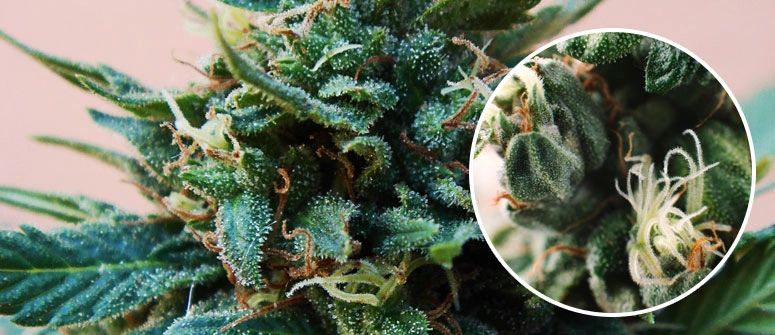
Female weed plants are the absolute preference to most growers who want big juicy buds to smoke, make medicine with or sell. This is because female flowers are coated in a thick layer of cannabinoid rich resin which determines its recreational and medicinal potential. This resin is produced by mushroom shaped glands on the plant called trichomes, effectively minute cannabinoid factories.
As well as having an obviously profound use among humans, this resinous substance is extremely important for the reproduction and evolution of the cannabis plant. It enables female plants to seize male pollen which results in the fertilisation of the plant. After fertilisation has taken place, the female plant will go into seed, ensuring the survival of the species and providing growers with breeding and cultivation potential.
However one important reason to detect the sex of plants early on is to single out the males and remove them from the growing space. This action will be taken by growers looking to optimise the quality and quantity of yields. If the female plants are kept away from the pollen produced by their male counterparts, they will start to produce far more valuable resin in a desperate attempt to capture pollen and become fertilised. If no pollen is to be found, the end result will be flowers covered in a dense layers of trichomes. This is due to the available resources being harnessed for resin production, instead of seed production.
A grower interviewed in the documentary Botany of Desire, based on the book of author Michael Pollan, described this scenario perfectly: "In essence, what you're seeing is extreme sexual frustration. This is a room full of women who are looking for some guy to come by and give them some pollen so they can create seeds. And they try harder and harder as time passes, and the more unsuccessful they are, the more production of the resins that are intended to attract pollen increases, and that increases the psychoactive elements of the plant."
These potent, unfertilised female flowers have been given the name sinsemilla, which is Spanish for "without seed". Sinsemilla is also defined as a "cannabis variety which has a particularly high concentration of narcotic agents". Meaning it will get you really, really high.
One definite way to detect if a plant is female will be the appearance of its sex organs, named pistils. These tiny white or orange hairs are the sex organs of female plants. Pistils will start to emerge at internodes, sections where branches intersect with main stem, at around 1.5 weeks into the flowering stage. Female flowers produce small tear-like calyxes with two pistils at this stage which will eventually grow and form together into what are commonly referred to as buds.
DISTINGUISHING MALE CANNABIS PLANTS
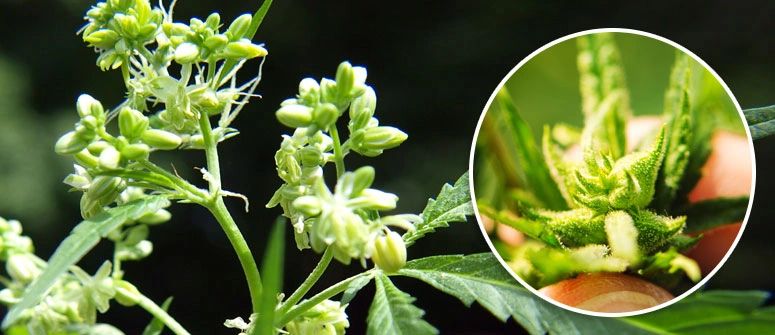
Mature male cannabis plants aren’t too difficult to tell apart from their female kin. During the seedling and vegetative phases of the growing cycle, however, it’s practically impossible to tell whether you are dealing with a male or female plant. At these early stages, plants are simply pumping out fan leaves to photosynthesize as much as possible in order to gain significant size and girth.
Male plants will begin to make themselves apparent during the initial period of the flowering phase. Some varieties will display what are called “preflowers” during this stage—mini versions of the mature structures that will occur later down the line.
Males will produce small, ball-like preflowers as opposed to the thread-like pistils produced by the ladies. If your plants aren’t showing any preflowers then you’ll have to wait another couple of weeks after the photoperiod has changed, keeping a close eye on any developments. These differences become much more obvious later on, to the point where it is pretty much impossible not to tell them apart.
One of the first signs you’ll notice is that the male plants in your crop have significantly thicker stalks than the females, and that these girthier structures possess fewer fan leaves than female specimens. This increased diameter serves the evolutionary purpose of supporting the taller heights of male plants.
Once the flowering phase has begun, you’ll want to constantly observe the nodes of your plants—the point at which the branches fuse with the main stem. This is the site where the reproductive organs of each sex emerge. In the case of males, you’ll notice clusters of small balls occur around 2 weeks after flowering has begun. These structures are in fact pollen sacs that produce and hold this reproductive material until the plant has reached a certain level of maturity.
HOW TO PREPARE YOUR GROW SPACE
Some growers in search of high performance buds remove all the male plants from the grow room or grow tent to prevent a transfer of energy. Once the pollen sac ruptures, and females are pollinated, they will convert all the energy that would have gone to flower production into seed production. This makes for a lower cannabinoid concentration in the buds and low yield if this is your end goal for harvest time.
However, seed production is still very important as cannabis and hemp are both annual plants. This mean they grow from seed, flower, and die all within a year. Where as perennial plants like trees grow from a seed and have many years of fruit or crop production throughout their life. This is why hemp/cannabis seeds are still very valuable and are becoming more of a mainstream crop.
These seeds are sought out not only for cannabis growers and hybridization, but also for the food industry. More and more frequently, hemp seeds are being used in kitchens and restaurants across the world for their high protein and fat content. They add a little more nutrition to each plate or smoothy.
Whatever your harvesting goals are, the ability to tell the male and female plants apart can go a long way.
Have you alread grow marijuana indoor ? If you haven’t been growing marijuana indoors yet,We suggest you to choose a indoor marijuana grow kits, the grow kits are simple to set up and makes it easier to begin growing. The first benefit of buying a complete grow tent kit is that it’s compact. Even if you have a small apartment with little closet space, you can set up a complete grow kit there. The second benefit is that you don’t need to go shopping for extra parts. These complete grow tent kits come with everything you need to start growing. This includes all electronics such as grow light with hangers, a circulation fan with carbon filters, and other necessities like nutrients for the plants. Finally, grow tent kits are moveable, so you can take them with you wherever you go. This is especially useful because grow tent kits are a big initial investment. Being able to pack up them up with you saves costs of setting up a new growing operation.
评论
发表评论